NC Gemstones: Emerald

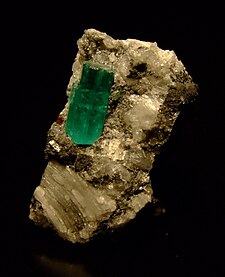 Emerald is a gemstone and a variety of the mineral beryl (Be3Al2(SiO3)6) colored green by trace amounts of chromium and sometimes vanadium.[2] Beryl has a hardness of 7.5–8 on the Mohs scale.[2] Most emeralds are highly included,[3] so their toughness (resistance to breakage) is classified as generally poor. Emerald is a cyclosilicate.
Properties determining value
Cut emeralds
Emeralds, like all colored gemstones, are graded using four basic parameters–the four Cs of Connoisseurship: Color, Clarity, Cut, and Carat weight. Before the 20th century, jewelers used the term water, as in “a gem of the finest water”,[5] to express the combination of two qualities: color and clarity. Normally, in the grading of colored gemstones, color is by far the most important criterion. However, in the grading of emeralds, clarity is considered a close second. Both are necessary conditions. A fine emerald must possess not only a pure verdant green hue as described below but also a high degree of transparency to be considered a top gem.[6]
In the 1960s, the American jewelry industry changed the definition of “emerald” to include the green vanadium-bearing beryl as emerald. As a result, vanadium emeralds purchased as emeralds in the United States are not recognized as such in the UK and Europe. In America, the distinction between traditional emeralds and the new vanadium kind is often reflected in the use of terms such as “Colombian Emerald”.[7]
Color
In gemology,[8] color is divided into three components: hue, saturation, and tone. Emeralds occur in hues ranging from yellow-green to blue-green, with the primary hue necessarily being green. Yellow and blue are the normal secondary hues found in emeralds. Only gems that are medium to dark in tone are considered emerald; light-toned gems are known instead by the species name green beryl. The finest emerald are approximately 75% tone on a scale where 0% tone would be colorless and 100% would be opaque black. In addition, a fine stone should be well saturated; the hue of an emerald should be bright (vivid). Gray is the normal saturation modifier or mask found in emerald; a grayish-green hue is a dull green hue.[6]